

W-Beam Guardrail Specifications Explained
W-beam guardrails are among the most widely used highway safety barriers in the world. Designed to redirect errant vehicles, reduce crash severity, and improve roadside safety, W-beam guardrail systems are a standard choice for highways, bridges, rural roads, parking areas, and industrial facilities. Understanding W-beam guardrail specifications is essential for engineers, contractors, distributors, and project owners seeking compliant and reliable roadway safety solutions.
This guide covers the key specifications of W-beam guardrails, including dimensions, materials, thickness, standards, components, and factors to consider when selecting the right system for your project.
What is a W-Beam Guardrail?
A W-beam guardrail is a semi-rigid roadside barrier made from corrugated steel. Its distinctive “W” profile—formed by two waves—provides strength and flexibility, allowing it to absorb impact energy while redirecting vehicles back onto the roadway.
Compared with rigid concrete barriers, W-beam guardrails offer a cost-effective balance of energy absorption, ease of installation, and maintenance efficiency. They are commonly installed along:
- Highways and expressways
- Bridges and overpasses
- Mountain roads and sharp curves
- Medians and roadside embankments
- Parking lots and industrial zones
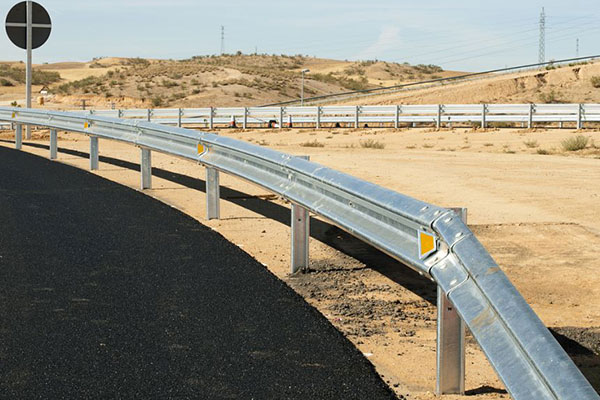
Standard W-Beam Guardrail Dimensions
W-beam guardrails are manufactured in standardized sizes to ensure compatibility with posts, spacers, and terminal sections.
Common Beam Lengths
- 4,320 mm (13 ft 6 in) – Standard effective length used in many international markets
- 4,000 mm – Common in specific regional projects
- 3,810 mm (12 ft 6 in) – Frequently used in North America
Cross-Section Dimensions
- Beam Width: 310 mm to 312 mm
- Wave Depth: 80 mm to 85 mm
- Flange Width: Approximately 55 mm
These dimensions provide the structural integrity needed to withstand vehicle impacts while maintaining controlled deflection.
W-Beam Guardrail Thickness Specifications
Guardrail thickness directly affects impact resistance, service life, and compliance with project requirements.
Standard Thickness Options
- 2.67 mm (12 gauge)
- 2.70 mm
- 3.00 mm
- 3.43 mm (10 gauge)
- 4.00 mm (for heavy-duty applications)
The most commonly specified thicknesses are 2.67 mm and 3.43 mm. Heavier gauges provide enhanced durability and are often selected for high-speed roads, bridges, and high-risk locations.
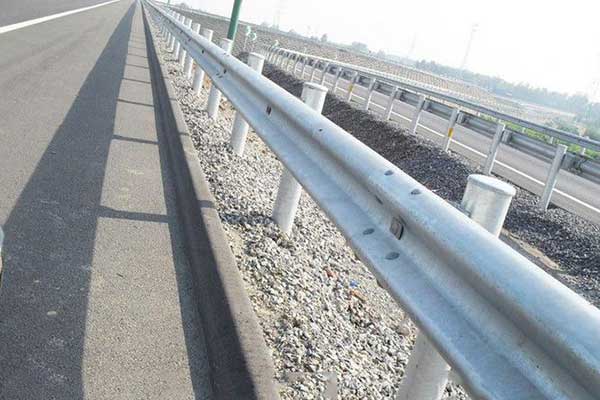
Materials Used in W-Beam Guardrails
W-beam guardrails are typically manufactured from high-strength steel to ensure durability, ductility, and impact performance.
Common Steel Grades
- Q235 steel
- Q345 steel
- ASTM A36 steel
- ASTM A572 Grade 50 steel
- S275JR / S355JR steel
Material selection depends on local standards, project specifications, and environmental conditions.
Surface Treatment and Corrosion Protection
To ensure long-term performance in outdoor environments, W-beam guardrails require corrosion-resistant coatings.
Hot-Dip Galvanizing
Hot-dip galvanization is the most common protective finish.
Coating Standard: ASTM A123, AASHTO M180, EN ISO 1461
Typical Zinc Coating Weight:
- 550 g/m²
- 610 g/m²
- 900 g/m²
- 1,100 g/m²
Galvanized W-beam guardrails provide excellent resistance to rust, moisture, salt spray, and harsh weather.
Powder Coating (Optional)
For enhanced aesthetics or additional protection, powder coating can be applied over galvanized steel. Common colors include:
- Green
- Gray
- Brown
- Custom project colors
Major International Standards for W-Beam Guardrails
Compliance with recognized standards is critical for safety and project approval.
1. North America
- AASHTO M180 – Standard Specification for Corrugated Sheet Steel Beams for Highway Guardrail
- MASH – Manual for Assessing Safety Hardware
- ASTM A123 – Zinc coating standard
2. Europe
- EN 1317 – Road restraint systems performance requirements
- EN ISO 1461 – Hot-dip galvanized coatings
3. Other International Standards
- AS/NZS 3845 (Australia/New Zealand)
- JT/T 281 (China)
- RAL-RG 620 (Germany)
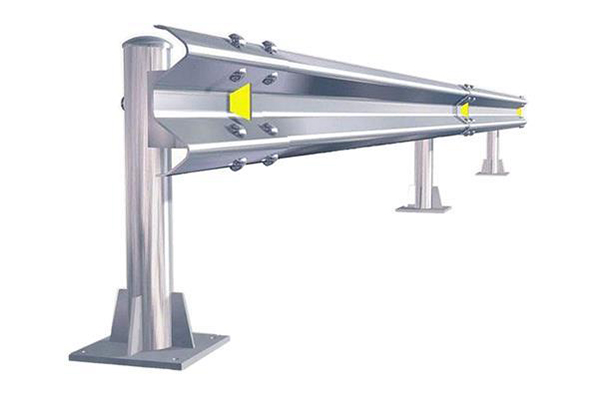
Main Components of a W-Beam Guardrail System
A complete W-beam guardrail installation includes multiple components working together as an integrated safety system.
Essential Components
- W-beam rail panels
- Steel posts (C-post, U-post, Sigma post, or I-beam post)
- Spacer blocks (steel or composite)
- Post caps
- Connection bolts and nuts
- Terminal end sections
- Transition sections
- Reflectors (optional)
Each component must meet the same applicable standards as the beam itself.
Typical W-Beam Guardrail Post Specifications
Common post sizes include:
- C-Post: 150 × 75 × 25 × 5 mm
- U-Post: 150 × 80 × 6 mm
- Sigma Post: 100 × 55 × 5 mm
- I-Beam Post: W150 or equivalent
Standard Post Lengths
- 1,830 mm
- 1,900 mm
- 2,000 mm
- Custom lengths available
Post spacing is typically:
- 1.905 m (6 ft 3 in) – Standard spacing
- 2.0 m – Common in many international projects
- 4.0 m – Special applications
W-Beam vs. Thrie-Beam Guardrail
While W-beam guardrails are the most common, Thrie-beam guardrails offer additional strength.
| Feature | W-Beam | Thrie-Beam |
|---|---|---|
| Number of Waves | 2 | 3 |
| Width | ~312 mm | ~506 mm |
| Strength | Standard | Higher |
Thrie-beam systems are often selected where greater containment or reduced deflection is required.
W-Beam Guardrail Price
W-beam guardrail prices typically range from about USD 15 to 50 per meter for a complete system depending on steel thickness, galvanizing requirements, compliance standards, and included accessories. Bulk orders and FOB China export terms can reduce the unit cost, while heavier thicknesses and higher zinc coating specifications will increase the overall price.
Summary
W-beam guardrails play a critical role in modern road safety systems by effectively reducing crash severity and protecting both drivers and roadside infrastructure. With standardized dimensions, durable steel construction, and internationally recognized specifications, they remain one of the most reliable and widely used highway safety solutions worldwide.
Finally, we hope you now have a clear understanding of W-beam guardrail specifications and how proper dimensions and standards play a key role in keeping roads safe. If you are looking for a reliable road safety products supplier for your project, please feel free to contact us for more details and a highly competitive quote.
FAQs
With proper hot-dip galvanizing, W-beam guardrails can last 20–30 years depending on environmental conditions.
W-beam has two waves and is used for standard road protection, while Thrie-beam has three waves and offers higher strength for bridges and high-risk areas.
Pricing depends on steel thickness, coating type, system components, order quantity, and shipping costs, usually quoted per meter or per set.
 English
  Español
  Français
  العربية
  Português
  Deutsch
  Русский
  Italiano